MALAYSIA SHOWS THE FUTURE OF ELEPHANT CONSERVATION
As I travel through Malaysia this week, I have found myself reflecting on one simple truth.
A nation's greatness is measured not only by the cities it builds, but by the wild places it chooses to protect.
Malaysia has become one of Southeast Asia's economic success stories. Modern highways connect thriving cities. New industries continue to grow. Yet beyond those highways lies something even more valuable: some of the oldest rainforests on Earth and one of the last strongholds of the endangered Asian elephant.
For most visitors, elephants are something they hope to see.
For Malaysia, they are something worth protecting.
That distinction matters.
Across Asia, elephant populations continue to decline. Habitat loss, expanding development, human-elephant conflict, and poaching have pushed one of the world's most intelligent and ecologically important species toward an uncertain future. Every new road, plantation, or housing development creates another challenge for elephants that have followed the same migration routes for centuries.
But during my time in Malaysia, I have also seen something encouraging.
I have seen a country that understands conservation and economic development do not have to be opposing forces.
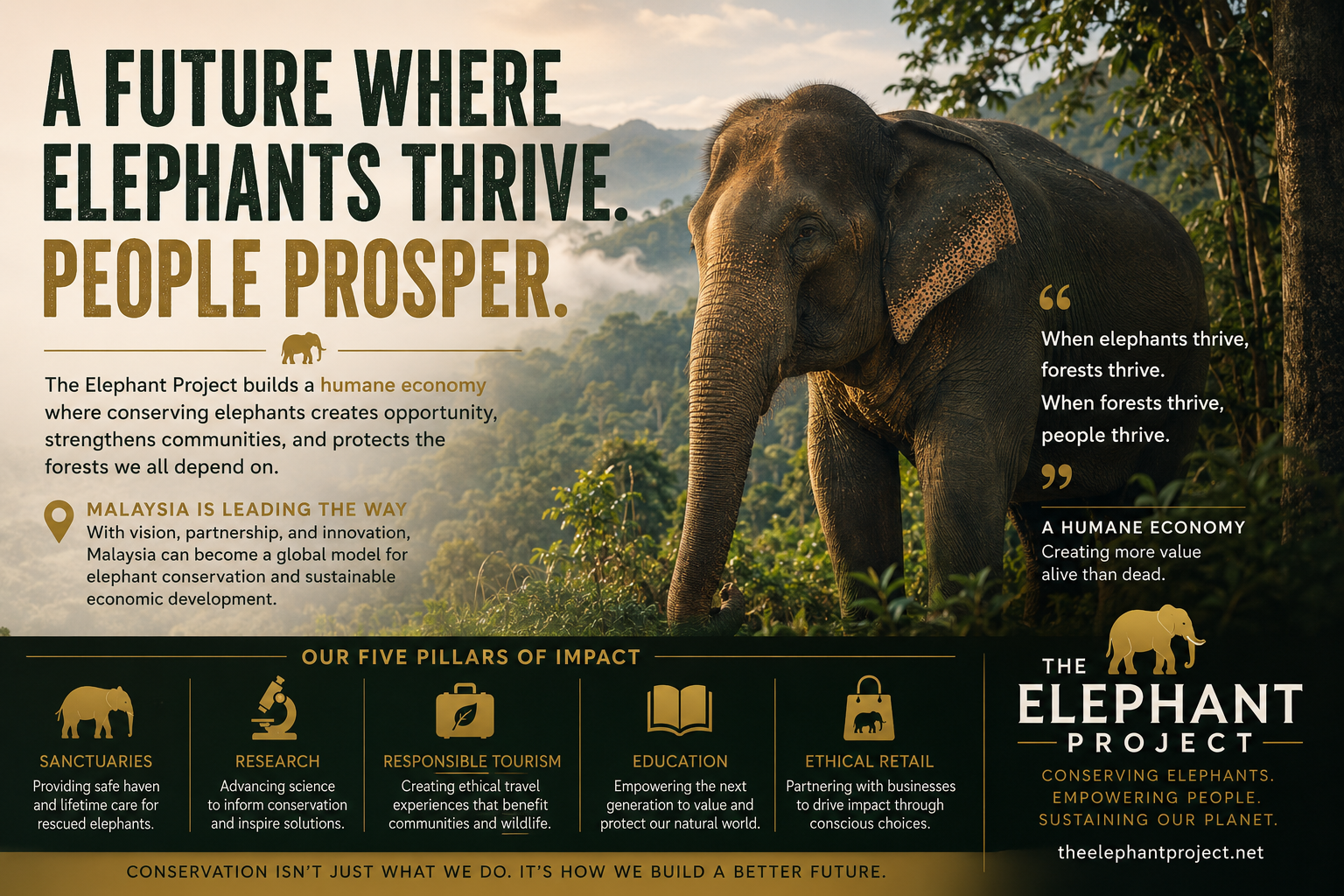
That belief is also the foundation of The Elephant Project.
Too often, conservation is framed as a choice between protecting wildlife and improving people's lives. It is presented as if governments, businesses, and local communities must sacrifice economic opportunity in order to save endangered species.
History shows that approach rarely succeeds.
People protect what creates value.
That is why The Elephant Project believes conservation must become an economic opportunity rather than an economic burden. We call it building a humane economy—one where protecting elephants generates jobs, attracts responsible tourism, supports scientific research, creates educational opportunities, encourages ethical investment, and strengthens local communities. In that model, a living elephant becomes infinitely more valuable than a dead one.
Malaysia is uniquely positioned to help lead that transformation.
Its forests already attract visitors from around the world. Its universities produce world-class researchers. Its businesses understand innovation. Its people possess a deep appreciation for the country's extraordinary biodiversity.
Imagine expanding wildlife corridors that reconnect fragmented forests.
Imagine conservation research centers attracting scientists from every continent.
Imagine local communities benefiting directly from eco-tourism, education, and sustainable enterprises that exist because elephants still roam Malaysia's forests.
Imagine young Malaysians growing up knowing they inherited not only a thriving economy but one of the world's greatest natural treasures.
This is not an unrealistic dream.
It is an achievable strategy.
The Asian elephant is more than a charismatic animal. It is a keystone species. As elephants move through forests, they disperse seeds, shape habitats, create clearings, and maintain the ecological balance upon which thousands of other species depend. Healthy elephant populations mean healthier forests, and healthy forests provide clean water, store carbon, support biodiversity, and strengthen resilience against climate change.
Protecting elephants is not simply about protecting one species.
It is about protecting entire ecosystems—and ultimately protecting ourselves.
During this visit to Malaysia, I have been reminded that conservation is never just about wildlife. It is about values. It is about deciding what kind of legacy we choose to leave behind.
Will future generations inherit forests still alive with elephants, hornbills, tapirs, and tigers?
Or will they inherit only photographs and stories of what once existed?
That decision belongs to all of us.
Governments have a role.
Businesses have a role.
Communities have a role.
Travelers have a role.
At The Elephant Project, we believe that the answer lies not in asking people to choose between prosperity and conservation, but in demonstrating that the two can—and must—exist together.
Malaysia has shown the world that rapid development is possible. Now it has an opportunity to demonstrate something even more important: that economic success and environmental stewardship can walk side by side.
As I leave this remarkable country, I will remember its welcoming people, its extraordinary diversity, and its ancient rainforests.
But I will also leave with hope.
Hope that countries like Malaysia can become global models for a future where protecting elephants is not viewed as a cost of development, but as one of its greatest investments.
Because when we create a world where elephants thrive, we create a world where people do too.